
War of Dots
Car Eats Car: Winter Adventure
Bomber Royale

Color Switch
Stacktris

Thumb Fighter
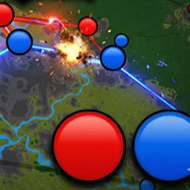
War of Dots Unblocked










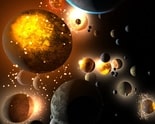
You start Universe Sandbox 2 with Earth intact, a full weapon list you haven’t touched yet, and no objective forcing your hand. Ten minutes later a black hole is slowly unraveling what used to be a continent, and the only reason any of it happened is that you wanted to see what would.
| Genre | Destruction sandbox |
| Modes | Planet Smash, System Smash |
| Weapon count | 34 unique weapons |
| Starting planet | Earth, expanding to Venus, Mercury, Mars, Jupiter, Saturn, Uranus, Neptune |
Every planet in Universe Sandbox 2 is built from voxels rather than a fixed 3D mesh, which is the detail that makes the whole destruction model work — a planet doesn’t just display damage, it’s genuinely made of destructible material all the way through. Cut deep enough with the right weapon and you’re not looking at a texture trick, you’re looking at whatever the game has generated beneath the surface.
What beginners get wrong first is assuming every planet reacts to damage the same way. It doesn’t — different planets have different core depths, and some have no core at all, which directly changes how the planet cools and reforms after being cut through. A weapon that opens a smoldering wound in one planet might pass through another with a completely different aftermath, purely because of what’s actually underneath the surface.
Planet Smash is where most new players spend their first sessions, working through Universe Sandbox 2’s weapon roster one at a time — lasers, meteors, nukes, antimatter missiles, and considerably stranger options like orbital ion cannons and space shibas. Nine of the 34 weapons can be customized further, adjusting color, strength, size, amount, velocity, or variant, and that customization is where a lot of the game’s real depth hides for players who only ever fire a weapon at its default settings.
Layering weapons matters more than most players expect on a first pass. A planet already weakened by a laser barrage reacts differently to a follow-up nuke than an untouched planet would, and escalating through a sequence of weapons rather than firing the strongest option first tends to produce far more dramatic, and more informative, destruction.
Where Planet Smash is about damaging a single world, System Smash is about moving celestial bodies against each other — dragging planets directly, using a Black Hole or a cluster of asteroids to disrupt orbits, or setting up a slingshot trajectory that sends one planet crashing into another. This is where Universe Sandbox 2 stops feeling like a demolition tool and starts feeling like an actual physics playground, since collisions here ripple outward and affect an entire system rather than a single isolated planet.
Two Lasers used together, or a coordinated Black Hole placement, can reshape an orbit in ways a single weapon never could — System Smash rewards thinking in terms of the whole solar system’s balance rather than one planet’s health.
Beyond the expected lasers and nukes, Universe Sandbox 2’s roster includes UFOs, battleships, space fighters, railguns, supernovas, laser swords, giant monsters, and celestial beings — plus defensive options like shields and defensive satellites that most players never touch, since the whole premise seems built around destruction rather than defense. That’s actually a mistake: setting up defensive satellites before an escalating weapon sequence gives a much clearer read on exactly how much damage a given attack is doing, since you can watch what the defenses fail to stop.
Artificial worlds and megastructures extend the sandbox even further past the traditional planetary lineup, and they behave differently enough from natural planets that strategies developed on Earth or Mars don’t always transfer directly.
The most common disagreement isn’t about the weapons themselves but about the game’s structure — some players want more built-in objectives or challenge modes layered on top of the sandbox, arguing that unlimited freedom without a goal eventually runs out of novelty. Others see the total absence of objectives as the entire point, insisting that any imposed goal would cheapen what makes Universe Sandbox 2 valuable in the first place: total, undirected experimentation.
Planet Smash, since it isolates weapon behavior on a single world without the added complexity of orbital mechanics, making it easier to learn what each weapon actually does before moving to System Smash’s larger-scale interactions.
Eventually, yes — the nine customizable weapons reveal much more of Universe Sandbox 2’s depth than their default settings suggest, but they’re worth exploring after you’ve got a baseline feel for how the uncustomized versions behave.
What keeps players coming back to Universe Sandbox 2 long after the novelty of a first black hole wears off is exactly that open-endedness — there’s always another planet, another weapon combination, another orbital setup nobody’s tried yet, and the game never runs out of ways to answer the same simple question of what happens if you push a little further.
