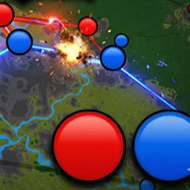
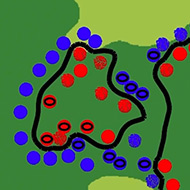
War of Dots is a minimalist real-time strategy experience built around clarity, speed, and tactical decision-making. Instead of overwhelming players with complex systems, it focuses on commanding armies, capturing cities, and outmaneuvering rivals in fast-paced battles across varied maps. Every match emphasizes awareness and planning, where even small tactical mistakes can shift the balance of power and determine the outcome.
Minimalist Strategy at Its Core
The defining strength of War of Dots is its stripped-down design philosophy. Every mechanic serves a clear purpose, allowing players to focus on strategy rather than micromanagement. The game removes unnecessary layers while preserving meaningful tactical depth, making each decision impactful from the opening moments to the final engagement.
There are only two unit types, each with a distinct battlefield role:
- Light units – inexpensive, versatile, and effective in large numbers across most terrains, ideal for rapid expansion and applying sustained pressure
- Heavy units – slower and terrain-dependent, but extremely durable and powerful in direct engagements, perfect for breaking fortified positions and anchoring defenses
This simplicity encourages experimentation, allowing players to quickly learn unit interactions while discovering advanced tactics over time. Mastering the timing of attacks and defensive placements separates casual players from skilled strategists.
City Control and Resource Management
Economy in War of Dots is directly tied to territorial control. Cities automatically generate and sustain units, creating a constant struggle for dominance. Each city can support up to five units, and exceeding this limit leads to attrition, forcing players to think carefully about expansion, consolidation, and timing.
Winning the game often depends on:
- Capturing cities to weaken enemy supply lines
- Maintaining balanced unit distribution across the map
- Timing attacks to disrupt production without overextending
Smart city management often proves more decisive than direct confrontation, allowing smaller forces to overcome larger ones through superior positioning and control.
Battle Flow and Tactical Timing
Combat in War of Dots unfolds in real time, rewarding sharp reactions and long-term planning alike. Because matches move quickly, positioning and timing matter more than sheer force. A well-placed heavy unit can break defenses, while coordinated light units can overwhelm opponents through sustained pressure and strategic encirclement.
Modes, Replays, and Skill Growth
The game supports multiple playstyles, from competitive encounters to custom scenarios. Full match replays allow players to review strategies, analyze mistakes, and refine tactics. This feature turns every defeat into a learning opportunity within War of Dots, encouraging steady improvement over time.
New players often ask whether mastery takes long. While the basics are easy to grasp, true skill comes from understanding timing, territory, and unit synergy—elements that define every intense match in War of Dots.