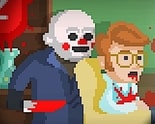
The company name on the business card reads like a joke — a one-person ghostbusting outfit that clearly doesn’t have its act together — and that’s exactly the tone The Happyhills Homicide opens with. It plays the whole premise for dry, self-aware comedy right up until it very deliberately stops being funny.
| Genre |
Point-and-click horror comedy |
| Role |
A struggling one-person ghostbusting outfit |
| Core mechanic |
Exploration, item interaction, environmental puzzles |
A Fake Exorcist Walks Into a Real Haunting
You start The Happyhills Homicide as someone running odd jobs under the banner of a ghostbusting business that mostly gets by on bluff and theatrics rather than any real ability to handle the supernatural. The framing is deliberately goofy — clients with mundane ghost complaints, a protagonist who talks a bigger game than they can back up — and that setup is what makes the eventual shift into something genuinely unsettling land as hard as it does.
What beginners get wrong early on is assuming the game’s comedic tone means the puzzles or the story stay lightweight throughout. They don’t. The Happyhills Homicide uses its early, funnier hours to lower a player’s guard specifically so the later turn hits without warning.
The Happyhills Homicide’s Puzzles Don’t Hold Your Hand
The point-and-click structure here rewards examining everything in a room rather than beelining for the one obviously interactive object. Item combinations and environmental details matter more than they first appear to, and the game rarely announces which detail is going to matter later — a joke prop in one scene can turn out to be load-bearing for a puzzle two scenes later.
Because there’s no timer and no combat system to speak of, the core skill The Happyhills Homicide actually tests is attentiveness: noticing the detail that doesn’t quite fit the room it’s in, and holding onto it mentally until the game gives you a reason to use it.
The Happyhills Homicide Twist Players Refuse to Spoil
Ask around about The Happyhills Homicide and you’ll notice a pattern: almost nobody who’s finished it will describe what actually happens partway through, only that something does, and that it recontextualizes everything leading up to it. That kind of community-wide restraint is rare, and it says something about how effective the shift genuinely is — most players who’ve experienced it firsthand treat spoiling it as a disservice to whoever plays it next.
What can be said honestly is that the game’s early comedic beats aren’t wasted setup — they’re doing real narrative work, establishing a tone specifically so its inversion carries weight instead of feeling arbitrary.
What Makes the Comedy Work Before the Turn
Dry humor carries most of The Happyhills Homicide’s opening stretch, and it’s a specific, character-driven kind of funny rather than slapstick — jokes that come from a protagonist who’s clearly out of their depth but too committed to admit it. That voice is consistent enough that players who came in expecting straightforward horror sometimes need a scene or two to recalibrate and realize the game knows exactly what it’s doing tonally.
This is also where the game builds its most memorable named details — the recurring bits and callbacks that longtime players quote back at each other — precisely because the comedic writing gives them room to land before the horror elements start closing in.
What Players Actually Debate About The Happyhills Homicide
Not every reaction is uniform. Some players feel the tonal whiplash between the comedic opening and the darker back half is the single best thing about the game — a structure that earns its twist through patient setup. Others find the shift too abrupt, arguing the comedy goes on long enough that the eventual turn feels like a different game bolted onto the first one. Both readings show up constantly in community discussion, and the game doesn’t make an obvious case for either being wrong.
Answering What New Players Actually Search For
Three questions come up constantly before people start The Happyhills Homicide. Is it actually scary, or mostly a comedy? It’s both, deliberately sequenced — funnier than expected early, and genuinely unsettling later, with the shift being the point rather than a flaw. How long does a full playthrough take? Short enough to finish in a single sitting, which is part of why the pacing of its tonal shift feels so tight rather than dragged out. Is prior knowledge of point-and-click conventions necessary? Not really — the puzzles reward attentiveness over genre familiarity, so a player new to the format isn’t meaningfully disadvantaged.
- Should new players avoid spoilers for The Happyhills Homicide? Strongly recommended — the community’s near-universal refusal to describe its turning point is itself a signal of how much the experience depends on going in blind.
- Does the humor undercut the horror, or build toward it? Most long-time players argue it builds toward it deliberately, using comedic trust as a setup for a shift that wouldn’t land the same way without it.
What stays with players after finishing The Happyhills Homicide usually isn’t a specific jump scare or puzzle — it’s the exact moment the joke stopped being one, and how much of the earlier comedy quietly recontextualizes itself in hindsight once you know where the story was always headed.