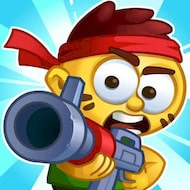
Somebody handed a three-year-old a grenade launcher, and Raft Wars wants you to just go with it. Simon digs up gold and diamonds on the beach, his brother Calvie shows up to help defend the loot, and within a few levels the two of them are trading fire with grown adults over a fortune two kids happened to find first.
| Genre |
Turn-Based Artillery / Physics Shooter |
| Core Loop |
Aim an arcing shot across water, knock enemies off their rafts, spend coins on upgrades |
| Cast |
Simon and his brother Calvie, defending their treasure level by level |
| Best For |
Players who enjoy trajectory-based aiming and steadily escalating enemy gauntlets |
Simon, Calvie, and Why Two Kids Are Fighting Grown Adults
The premise is played completely straight despite how absurd it sounds out loud: Simon finds treasure, other people want it, and rather than calling in adult help, his older brother Calvie — recognizable by his Superman shirt and red cape — joins him in defending it with tennis balls, grenades, and eventually rockets. That tonal commitment is a big part of why Raft Wars works as comedy without ever undercutting the actual gameplay; nobody in the story treats the situation as strange, so the escalating arsenal just feels like the natural next step in an ongoing turf war.
Calvie’s role expands as the game progresses, shifting from a background presence early on to an active participant defending the treasure alongside Simon. That shift roughly tracks with the game’s own escalation — the deeper you get, the less believable it becomes that Simon is handling this alone, and Calvie’s growing involvement mirrors that shift narratively as much as mechanically.
Pirates, Vikings, and the Rest of Raft Wars’ Level Bosses
Each stretch of levels introduces a new group with its own visual identity and behavior: Pirates as the opening act, Vikings adding new positioning challenges, City Thugs bringing a different, more modern threat, and eventually the Neighbors — whose grudge runs deep enough that they escalate into kidnapping Simon and Calvie’s own parents, who then return as corrupted, hostile bosses themselves. That last twist is the game’s boldest narrative swing, turning what starts as a lighthearted treasure squabble into something with genuine stakes by making the final threats personal rather than just another faction.
- Pirates: the gentlest introduction, teaching straightforward full-power aiming without much need for angle adjustment.
- Vikings: frequently positioned on elevated terrain, forcing you to actually adjust your arc rather than repeat the same shot.
- City Thugs: a tonal shift into a more modern setting, with enemy positioning that starts rewarding smarter targeting over brute force.
- Neighbors and corrupted parents: the story’s emotional and difficulty peak, where the “just kids defending treasure” framing gives way to genuinely higher stakes.
The Hippo Everyone Complains About
Ask around about Raft Wars long enough and one specific obstacle comes up repeatedly: a hippo that blocks or complicates your shots in ways players consistently describe as frustrating. It’s not a subtle design element — it’s called out directly and often as one of the more annoying roadblocks in the whole game, less because it’s mechanically complex and more because it disrupts the clean aiming rhythm the rest of the game trains you to rely on.
Getting past it usually comes down to patience rather than a clever trick: adjusting your angle to route around it rather than trying to power through with a direct shot, since the obstacle is specifically placed to punish players who’ve gotten comfortable firing the same straight-line shot that worked against Pirates and early Vikings.
Turtle Bombs and Other Enemies That Feel Unfair
Alongside the hippo, turtle bombs show up in player complaints as a specifically overpowered enemy type — explosive threats that punish careless positioning harder than most other obstacles in the game. Both the hippo and turtle bombs share a common thread in player feedback: they’re the moments where Raft Wars’ otherwise forgiving arc-and-fire loop suddenly demands more precision than the rest of the level trained you to expect.
Aiming Arcs: What the Early Levels Actually Teach You
Raft Wars’ level design doubles as an unstated tutorial in trajectory reading. Pirates reward full-power, straight-line shots with little need for finesse. The introduction of Vikings on elevated terrain forces your first real angle adjustments. By the time City Thugs show up, positioning behind obstacles like jet skis means grenades — with their wider blast radius — start outperforming direct-hit weapons for certain angles.
- Full-power straight shots work fine against early, exposed enemies with no elevation advantage.
- Elevated enemies require deliberately reducing power and increasing arc rather than firing your default shot at a steeper angle.
- Enemies tucked behind cover, common from City Thugs onward, are frequently better handled with grenades than with direct-fire weapons.
The Difficulty Spike Late in the Game
Player feedback is unusually consistent about where Raft Wars gets genuinely hard: a late-game stretch where players report feeling outnumbered and outgunned, facing enemies that land hits with a consistency earlier levels never asked players to deal with. It’s a noticeable jump rather than a gradual increase, and it arrives after several levels where players commonly report becoming fully upgraded well before the game actually ends — meaning the difficulty spike lands at a point where there’s often nothing left to spend coins on to prepare for it.
That combination — a short upgrade curve paired with a late, sharp difficulty increase — is the most common structural criticism of the game, alongside smaller complaints like wanting number-key shortcuts for weapon switching instead of relying on the mouse alone.
Why Raft Wars 2 Trades the Neighbors for a Water Park
Raft Wars 2 makes a deliberate break from the original’s faction-by-faction structure, moving the entire setting to a water park populated by lifeguards and security guards rather than pirates, Vikings, and vengeful neighbors. Simon and Calvie also start the sequel already working together, rather than Calvie joining partway through as he does in the original — a small change that reflects how much of the first game’s story was actually about Calvie’s escalating involvement.
Neither approach is strictly better; the original’s slow escalation from petty treasure squabble to family-stakes finale gives it a narrative arc the sequel doesn’t really attempt, while the water park setting trades that arc for a more consistent, single-setting tone throughout.
What’s the trick to getting past the hippo in Raft Wars?
There’s no special weapon that bypasses it cleanly — the reliable approach is adjusting your firing angle to arc around it rather than trying to power through with the direct shots that work against Pirates and early Vikings.
What’s the best weapon upgrade order in Raft Wars?
Given how often players report becoming fully upgraded well before the game’s hardest stretch, the safer approach is spreading upgrades gradually across the early and mid-game rather than rushing top-tier weapons immediately, so you’re not left with nothing meaningful to save toward once the late-game difficulty spike arrives.
How is Raft Wars 2 different from the original Raft Wars?
The sequel replaces the original’s pirates-to-Vikings-to-Neighbors escalation with a single water park setting featuring lifeguards and security guards, and starts Simon and Calvie as an already-established team rather than building toward Calvie’s involvement over the course of the story.
Raft Wars earns its reputation less from any single mechanic and more from how deliberately it escalates — from Simon and Calvie’s first shots at Pirates to a finale that turns their own parents into the final obstacle, the arc of the story matches the arc of every shot you have to line up along the way.