


War of Dots

Car Eats Car: Winter Adventure
Bomber Royale

Color Switch

Stacktris

Thumb Fighter
War of Dots Unblocked











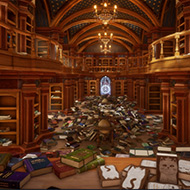
A missing body doesn’t stay hidden from a pencil. Librarian: Tidy Up The Arcane Library! hands you a cursed sketchbook and a crime scene instead of a mop and a shelving cart, and the first thing it makes clear is that finding a clue isn’t the same as understanding it — you still have to draw the thing correctly before the game believes you’ve actually seen it.
| Genre | Point-and-Click Detective / Puzzle |
| Core Loop | Search hand-drawn scenes, then sketch each clue to confirm it |
| Session Length | Roughly 5–10 minutes for a full case |
| Best For | Players who like puzzles built around close observation over reflexes |
The premise is simple to state and uncomfortable to sit with: a veteran, father, and husband named Richard Green is dead, his body has gone missing, and you’re the one holding the cursed artifact that’s supposed to make sense of what happened. That artifact is the sketchbook itself — not a magnifying glass, not an evidence board, but a pencil that forces you to physically recreate whatever you’ve found before the game treats it as real evidence. It’s a small mechanical twist on the usual point-and-click formula, and it changes the pacing of every scene, because spotting an object in the background isn’t the end of a puzzle here, it’s the start of one.
Where the game earns its “arcane” framing isn’t through spellbooks or rituals, but through how it treats the drawing tool itself as something with weight and history — a device that channels a case’s darker details through your hand rather than just your eyes. That framing turns an otherwise straightforward detective story into something closer to psychological horror without ever needing to change the core loop.
Richard Green isn’t a background name mentioned once and forgotten — his absence is the entire mystery, and the game builds outward from a single unanswered question: how does a body vanish from a crime scene before an investigation even properly starts? Clues you sketch throughout the case circle back to what happened to him specifically, rather than dispersing into an unrelated collection of trivia, which keeps the puzzle-solving tied tightly to the actual plot instead of feeling like busywork bolted onto a story.
Part of what makes Richard Green’s case land is that the game doesn’t rush to explain the family tension surrounding him. An affair involving his wife is present in the background of the story, colouring motives without ever being spelled out directly, and it’s left largely to the player to connect that detail to what actually happened rather than having a character state it outright.
Timmy, Richard’s son, is the story’s quietest and most effective piece of writing — a character whose grief and pent-up emotion build silently in the margins of scenes that are ostensibly about physical evidence rather than about him. He’s not framed as a suspect in any obvious sense, but the way his presence recurs throughout the case makes it clear the game wants you paying attention to him specifically, not just to the objects scattered around each scene.
That restraint is unusual for a short case-based mystery. Plenty of games in this format would make a grieving son either an obvious red herring or an obvious source of the twist; this one lets Timmy sit uncomfortably in between for most of the runtime, which is exactly why the eventual reveal involving him tends to hit harder than expected.
The sketching mechanic is what separates this from a standard hidden-object case file, and it works because the game doesn’t let you fake your way through it. Finding a gun in a cluttered scene is only step one — you then have to manually draw its shape and position from memory or reference, and getting it wrong doesn’t always throw up an obvious error message, it just leaves the deduction incomplete until you get closer to correct.
The drawing requirement also changes how players approach searching a scene in the first place. Instead of clicking rapidly across the screen hoping to trigger a hotspot, the smarter habit is slowing down to actually register the shape of what you’re looking at, since you’ll need to reproduce it by hand moments later.
Player reaction to the ending is unusually consistent for a short game: people call it out specifically, and not gently. Comments describing the final reveal as brutal or evil are common, and the specificity of that reaction — players naming the twist directly rather than just saying the ending was “good” — suggests the writing sticks the landing on Richard Green’s case in a way a lot of short detective games don’t manage.
Part of why the twist works is the restraint discussed earlier around Timmy and the unspoken affair — because the game never over-explains its background details, the final connection between Richard Green, his family, and what actually happened to his body lands as a genuine recontextualization rather than a reveal you saw coming from the halfway point.
The most consistent complaint isn’t about the writing or the mystery itself, it’s technical friction: the sketching input can lag or misread strokes, which turns what should be a quick confirm-the-clue moment into a repeated, occasionally annoying retry. It’s a real rough edge, and going in expecting the drawing to occasionally fight you rather than always respond cleanly will save some frustration.
That said, the complaint is specifically about input responsiveness, not about the drawing mechanic’s design — nobody arguing the sketching should be removed, just that it should register more reliably. It’s the kind of friction that’s easy to forgive once Richard Green’s case actually resolves, but it’s fair to flag before going in.
No — the sketching doesn’t require artistic skill, just a rough, recognizable approximation of the clue’s shape and position. The game is checking whether you actually registered what you found, not judging your linework.
It’s built quietly rather than either telegraphed or random — details around Timmy and the unspoken affair are present from early on, but understated enough that most players report being genuinely caught off guard by how they connect at the end.
Slow down and use fewer, more deliberate strokes rather than trying to perfect the shape in one motion — the recognition is checking rough position and form, and simpler input tends to register more reliably than an overly detailed attempt.
Librarian: Tidy Up The Arcane Library! turns a short case file into something genuinely unsettling by making you complicit in every piece of evidence you uncover — by the time Richard Green’s story resolves and Timmy’s role in it becomes clear, the pencil in your hand feels a lot less like a tool and a lot more like a witness.
