
War of Dots
Car Eats Car: Winter Adventure
Bomber Royale

Color Switch
Stacktris
Thumb Fighter
War of Dots Unblocked


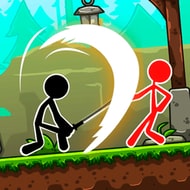






You hop toward your opponent, weapon arm cocked back, and the moment before impact everything is still readable — the angle of the swing, the gap in their guard, the half-second where their shield arm drifts too low. Then the hit lands and both ragdolls fold in directions no animator would have drawn on purpose. That collision of readable intent and physics-driven chaos is the whole appeal of Gladihoppers, and it’s why a fight that looks like slapstick on the surface keeps rewarding players who actually study it.
| Genre | Physics fighting / gladiator combat |
| Modes | Career, Arcade, Practice, 1v1 arena |
| Core mechanic | Independent weapon-arm and shield-arm control |
| Weapons | Swords, spears, axes, shields, and more |
The single mechanic that separates Gladihoppers from a generic ragdoll brawler is that your two arms don’t move together. One hand carries the weapon, the other carries a shield, and you’re expected to operate both at once — swinging with one while angling the other to catch an incoming strike. Early on, most players just mash the attack button and let physics sort out the rest. That works for the first few arena bouts, then stops working the moment an opponent starts feeding you counters off a blocked swing.
What beginners get wrong is treating the shield arm as passive. It isn’t. A shield left hanging at a bad angle doesn’t block anything — it just adds mass to your ragdoll that the next hit gets to fling around. Players who start deliberately repositioning the shield arm between swings, rather than leaving it wherever the last animation dropped it, notice their survival time in Arcade mode jump almost immediately.
Hopping itself is not just movement. Momentum carried into a swing changes how hard it lands — a stationary attack barely rocks an opponent, while the same swing thrown mid-hop can cripple a leg or knock a weapon loose outright. Community discussion around the game consistently comes back to this: distance management through hopping is treated as a fight-deciding skill, not flavor.
Gladihoppers skips the generic health bar in favor of targeting specific limbs, and that single design choice changes how every fight is read. Cripple a leg and the opponent’s hop becomes a stumble — they can’t close distance or retreat cleanly for the rest of the round. Knock the weapon out of a hand and you’ve forced a scramble where they either fight bare-fisted or waste a swing recovering it.
This is where weapon choice stops being cosmetic. A spear’s reach lets you threaten a leg from outside counter range, while a shorter weapon like an axe trades that reach for faster recovery between swings. Switching from a longer weapon to a shorter one mid-Career run changes your entire rhythm — the angles that worked a moment ago stop landing, and the ones that didn’t start connecting.
Boss encounters push this further. Fights against the larger, heavier opponents later in Career mode punish players who fight them the same way they fight a standard gladiator — the extra mass changes how much momentum a hop-swing needs to actually stagger them, and players who don’t adjust find their usual openings simply absorbed.
Practice mode gets treated as a formality by a lot of players, which is a mistake specific to Gladihoppers in a way it isn’t for most fighting games. Because hits land based on physics rather than fixed animations, the same swing genuinely lands differently depending on your exact positioning and momentum — there’s no fixed frame data to memorize. Practice is where you build a feel for that variance instead of a script.
Players who skip straight to Arcade or the 1v1 arena mode tend to plateau earlier, since they’re learning the limb-targeting system live against opponents who are also adapting, rather than in a setting where they can isolate one variable at a time.
Not everything about Gladihoppers lands cleanly with its community. The physics-first combat that makes early fights so funny can, in longer 1v1 sessions, produce outcomes that feel more like a lucky ragdoll flail than a earned read — a well-aimed swing occasionally does less than a mistimed one purely because of how the limbs tumbled. Players who came in expecting tight, deterministic fighting-game logic tend to bounce off this; players who came in treating the physics as the point tend to embrace it as exactly what keeps 1v1 matches from feeling solved.
That tension is honestly part of what keeps the arena mode replayable. A weapon matchup that should favor the longer reach doesn’t always play out that way once momentum and limb collisions get involved, and the games where it goes sideways are usually the ones players remember.
A mid-length weapon like a sword is the usual recommendation, since it gives enough reach to threaten a leg without the slower recovery of a spear or axe. Shields, meanwhile, matter more than any weapon choice — get comfortable repositioning the shield arm before worrying about which weapon feels best.
Because damage in Gladihoppers is resolved through limb collisions and momentum rather than a flat number, a swing that connects at a bad angle or with too little hop-momentum behind it can land visually but barely affect the fight. Building hop-momentum into an attack, rather than swinging from a standstill, fixes most of this.
Not strictly, but Career mode’s boss fights are where most players first learn to adjust their targeting against heavier opponents — a lesson that transfers directly to the arena mode’s tougher matchups.
None of that changes what makes people come back to Gladihoppers after the first few clumsy bouts: the moment a hop-timed swing catches a shield arm at exactly the wrong angle and sends an opponent’s weapon spinning out of frame, the game stops being slapstick and starts being a fight you actually won.
