

War of Dots
Car Eats Car: Winter Adventure
Bomber Royale

Color Switch
Stacktris

Thumb Fighter
War of Dots Unblocked










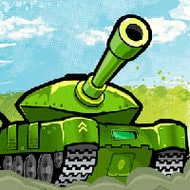
You roll into a new arena, barely register the layout, and a Ricochet Tank already has a shot bouncing toward you off a wall you hadn’t even noticed. That’s a normal opening few seconds in Awesome Tanks 2 — the game doesn’t ease you into its levels so much as drop you into them already moving.
| Genre | Top-Down Tank Arena Shooter |
| Core Loop | Clear enemy spawners across 15 levels, upgrading your tank between fights |
| Enemy Variety | Seven distinct tank types plus stationary turrets and boss-tier “Kings” |
| Upgrade Depth | Ten separate upgrade tracks spanning weapons, armor, and mobility |
Across all fifteen levels, Awesome Tanks 2 keeps changing the terms of engagement — different spawner placements, different scenery blocking sightlines, different obstacle layouts that either protect you or box you in depending on how well you’ve learned that level’s shape. Controls stay simple throughout: movement on WASD or the arrow keys, aiming and firing with the mouse, cycling weapons with spacebar or Q and E, and laying mines with Shift. What changes constantly is what those controls need to accomplish against a given level’s specific mix of threats.
That level-to-level variety is what keeps a fifteen-level roster from feeling repetitive despite the core loop staying identical throughout: enter, destroy the spawners, survive what they’ve already sent out, move on. Later levels don’t just add more enemies, they change which enemies show up together, forcing weapon and positioning choices that earlier levels never demanded.
Two enemy types define the early learning curve more than any others: the Ricochet Tank, whose shots bounce off surfaces in ways that make “behind cover” a much less reliable idea than it sounds, and the Railgun Tank, which hits harder per shot than almost anything else you’ll face in the opening levels. Learning to read a Ricochet Tank’s likely bounce angle before it fires is one of the first real skills the game demands, since standing in a spot that looks safe on a straight-line basis is often exactly where a ricocheted shot ends up landing.
Railgun Tanks reward a different instinct: closing distance or breaking sightlines matters more against them than trading shots at range, since their hits carry enough weight that a prolonged exchange rarely favors you.
Regular Ricochet and Railgun Tanks get a boss-tier upgrade in King Ricochet and King Railgun — larger, tougher versions that show up as genuine set-piece fights rather than just another spawner to clear. These “Kings” sit above regular enemy tanks and the game’s stationary Turrets in raw threat level, and they’re usually the moment a level stops being a rhythm of small skirmishes and becomes a single, sustained fight you need to actually plan for.
Among the seven named enemy tank types — Ricochet, Railgun, Rocket, Laser, Flamethrower, Blaster, and Kamikaze — the Kamikaze Tank creates a genuinely different kind of pressure than the rest. Where most enemies are a ranged math problem, a Kamikaze Tank is a closing-distance problem: letting it get close is a mistake in a way that shrugging off a few Blaster Tank shots simply isn’t.
Rocket, Laser, and Flamethrower Tanks each carve out their own niche too — rockets demanding you break line of sight rather than out-tank the blast, lasers punishing you for standing still in a beam’s path, flamethrowers turning close-quarters encounters dangerous fast. Learning which of the seven types you’re looking at, at a glance, is arguably the single most transferable skill across all fifteen levels.
Awesome Tanks 2 expands the upgrade system well past a simple armor-and-firepower split, spreading progression across ten distinct tracks in total. That breadth means coin allocation between runs is a real decision rather than an obvious “max everything eventually” grind, since early levels don’t hand out enough currency to spread investment thin without consequence.
Weapon choice in Awesome Tanks 2 comes down to a real trade-off rather than one obviously correct pick. The laser’s constant-stream damage makes it a favorite against crowded waves of weaker enemies, the cannon’s slower reload is offset by strong, cheap damage per hit that holds up surprisingly well across most of the game, and the railgun rewards more precise aim with high per-shot power, including the ability to hit targets through certain obstacles that would block other weapons entirely.
The minigun, shotgun, ricochet weapon, and flamethrower round out the arsenal, each with a smaller but genuine niche — the ricochet weapon in particular is often overlooked early on despite becoming efficient once its own upgrades are invested in, since its bounce behavior mirrors the enemy Ricochet Tank’s own trick used against you.
Mines, laid with Shift, are frequently underused by players who default to whichever weapon they’re actively holding, but they’re specifically recommended by experienced players against King-tier bosses, where a pre-placed mine can land a chunk of damage without you needing to expose yourself in the open. Blue crystal pickups add another situational tool, temporarily freezing nearby enemies and creating a brief window to reposition or focus fire that the moment-to-moment combat doesn’t otherwise offer.
Neither tool is necessary to clear early levels, which is exactly why they’re easy to ignore — but by the time King Ricochet or King Railgun shows up, players who’ve learned to fold mines and crystal pickups into their approach have a noticeably easier time than those relying purely on their primary weapon.
The praise for Awesome Tanks 2 is consistent — players call it addictive, fast, and satisfying in short bursts — but the complaints are just as consistent and worth knowing before going in. A number of players note the game becomes noticeably easier once you’ve settled on an optimal weapon and upgrade path, flattening the challenge curve in the back half of the fifteen levels. Others point to occasional lag or screen-shake during busy fights, and the specific annoyance of physically getting stuck against another tank’s collision box mid-fight. A smaller but recurring complaint concerns a promotional link overlay appearing after finishing a level, which several players describe as an unwelcome interruption right after a hard-fought win.
Awesome Tanks 2 earns its replayability from variety rather than raw difficulty — seven enemy tank types, two King-tier bosses, and ten upgrade tracks give it enough moving parts that even players who’ve cleared all fifteen levels once still find new combinations worth trying on a second pass.
