

War of Dots

Car Eats Car: Winter Adventure
Bomber Royale

Color Switch

Stacktris

Thumb Fighter
War of Dots Unblocked











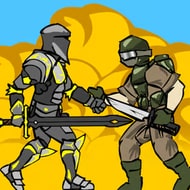
Age of War looks like a simple tug-of-war between two lanes of marching stick figures, but it plays like a resource-management puzzle wearing a war costume. Every gold coin you spend now is a coin you can’t spend on the unit that would counter what’s coming in thirty seconds, and the game never lets you forget it.
| Genre | Side-Scrolling Base Defense / Strategy |
| Core Loop | Spend gold on units and turrets, earn XP from kills, evolve through five ages |
| Ages | Stone, Medieval, Renaissance, Modern, and Future |
| Difficulty Options | Normal, Harder, and Impossible, each raising enemy stats further |
The entire game plays out across a single horizontal lane, with your base on one side and the enemy’s on the other. Units you buy march automatically toward the enemy base, engaging whatever they meet along the way, while gold from kills funds your next purchase and experience points slowly fill a meter that unlocks the next age. That’s the whole loop, repeated five times as you climb from Stone Age clubs to Future Age war machines, and the elegance of Age of War is that the loop never needs a tutorial beyond its first thirty seconds to make sense.
What isn’t obvious immediately is how much the correct strategy changes between ages. Early on, cheap units in bulk beat sparse expensive ones because the lane is short and skirmishes are quick. By the Modern and Future ages, unit costs scale so far past early-game gold income that a single mistimed purchase can leave you defenseless for an uncomfortably long stretch while your base absorbs damage you can’t answer.
Your first units are the Club Man and the Slingshot Man, cheap enough to spam without much thought, with the Dino Rider sitting well above both in cost as the age’s heaviest option. Turret choices follow the same spread — a cheap Rock Slingshot, a mid-cost Egg Automatic, and a pricier Primitive Catapult — and the temptation early on is to dump every coin into units the instant they’re available.
The better habit, and one repeated across serious strategy discussion of this game, is patience: let two or three enemies bunch up near your base before using your special attack, rather than firing it off reactively the moment it’s available. A Meteor Shower wasted on a single approaching unit is a wasted cooldown; the same special used against a cluster is often worth several units’ worth of gold in kills alone.
The jump into the Medieval Age introduces the Swordman and Archer as the new baseline, with the Knight arriving as a genuinely expensive investment relative to everything before it. This is where a lot of first-time players hit their first real strategic wall: the Knight looks like an obvious upgrade over spamming Swordmen, but its cost means overcommitting to Knights early can leave you thin on the board while the enemy simply keeps producing cheaper units.
Community strategy write-ups consistently recommend a specific rhythm here — building up a run of Swordmen first, adding a single Knight once the economy supports it, and using your special attack to clear a logjam before repeating the cycle rather than continuously trickling out units one at a time. Turret options in this age scale similarly: a base Catapult, a Fire Catapult with added burn value, and Oil as the most expensive defensive option, each worth slotting in as your gold income actually catches up to their cost.
By the Renaissance Age, unit costs have grown enough that careless spending genuinely costs games. The Dueler and Musketeer form a cheaper backbone, while the Cannoneer represents a serious investment — and turret costs jump even harder here, from a Small Cannon up through a Large Cannon to an Explosive Cannon priced well beyond either.
This is the age where turret investment starts to matter as much as unit spam. Because enemy units are hitting harder and turrets don’t consume a “slot” the way units march and die, a well-placed Explosive Cannon can quietly do more sustained damage over a match than an equivalent amount of gold spent on Cannoneers that die to enemy fire before reaching the base.
Modern Age costs stop being small numbers entirely — Melee Infantry and Infantry sit in the low thousands, while the Tank represents a genuinely serious commitment of gold. Turret pricing tells the same story: a Single Turret, a Rocket Launcher, and a Double Turret priced high enough that fielding even one requires real economic patience.
This banking approach — deliberately holding gold to complete a bigger purchase rather than spending as soon as funds allow — is the single most commonly repeated piece of advice for the Modern Age specifically, because the gap between “almost enough for a Double Turret” and “enough for a Double Turret” is the difference between a stable defense and a base taking unanswered hits for several seconds.
The Future Age tops out with the Super Soldier, priced so far above every other unit in the game that it functions as the closest thing Age of War has to an “ultimate unit,” alongside cheaper but still substantial options like God’s Blade, Blaster, and War Machine. It’s tempting to treat the Super Soldier as the age’s central strategic goal, but saving exclusively toward it while your board sits empty is a common and costly mistake — the mid-cost Future Age units still need to hold the line while you accumulate that kind of gold.
The real threat in the Future Age is rarely the enemy’s own Super Soldier arriving unexpectedly; it’s the accumulated pressure of mid-tier Future units chipping away at a base that spent too long saving for one big purchase instead of maintaining a steady defense.
Normal difficulty is where most players learn the game’s rhythm, but Harder and Impossible modes push enemy stats meaningfully higher, and Impossible specifically has developed a reputation in community discussion as a genuine test of whether the era-by-era strategies above actually hold up under pressure. Enemy units hit harder and appear more aggressively on Impossible, which punishes the “spend reactively” habit far more severely than Normal difficulty ever does.
Players who’ve written up successful Impossible runs describe an approach that’s really just a stricter version of good habits from every age: clustering enemies before using specials, banking gold deliberately rather than spending the instant it’s available, and treating turret investment as equally important to unit spam rather than an afterthought. Whether Impossible is reliably beatable at all remains something players actively debate, which says a lot about how much the difficulty setting changes the game’s math compared to Normal.
Players who go looking for more Age of War often land on its sequel, and it’s worth knowing upfront that the two aren’t the same experience wearing a new coat of paint. The sequel reworks the unit and turret roster from the ground up, adds two entirely new eras on top of the original five, and changes how special attacks function — costing experience points to use rather than running on a simple cooldown. That last change alone shifts strategy meaningfully, since XP is no longer purely a resource for evolving ages; it becomes something you’re also spending on specials, which changes the calculus of when to hold back and when to commit.
None of that makes the sequel better or worse, just genuinely different — a player who’s mastered the original’s cooldown-based specials and five-age structure will find the sequel asks slightly different questions rather than simply offering more of the same content.
Consistency in habits that matter less on Normal — clustering enemies before firing your special, banking gold for turret upgrades instead of spending reactively, and not neglecting turret slots in favor of pure unit spam — becomes essential on Impossible, where enemy stat increases punish sloppy spending far more severely.
Not automatically. Its cost is high enough that saving exclusively toward it while ignoring mid-tier Future Age units and turret upgrades often leaves your base exposed in the meantime — a steady defense supplemented eventually by a Super Soldier tends to outperform an empty board followed by one huge purchase.
No — it shares the core five-ages-plus concept but reworks the unit roster, adds two additional eras, and changes special attacks to cost experience rather than running on cooldown, making it a distinct strategic experience rather than a simple re-skin of the original.
Age of War rewards exactly the kind of patience its stick-figure presentation doesn’t advertise — from the first cheap Club Man to a fully saved-for Super Soldier, the players who actually clear Impossible difficulty are the ones who treat every age’s economy as seriously as the last, not the ones chasing the flashiest unit on the roster.
